
Ship APIs with confidence—automatically.
Our API automation suite validates every endpoint beyond “200 OK,” proving real success/failure behavior (isSuccess, message) while enforcing schema, types, and nested-field rules. It also guards non-functional expectations like response size, performance, pagination limits, caching, and queue logging—so breaking changes and hidden errors get caught on the very first run.
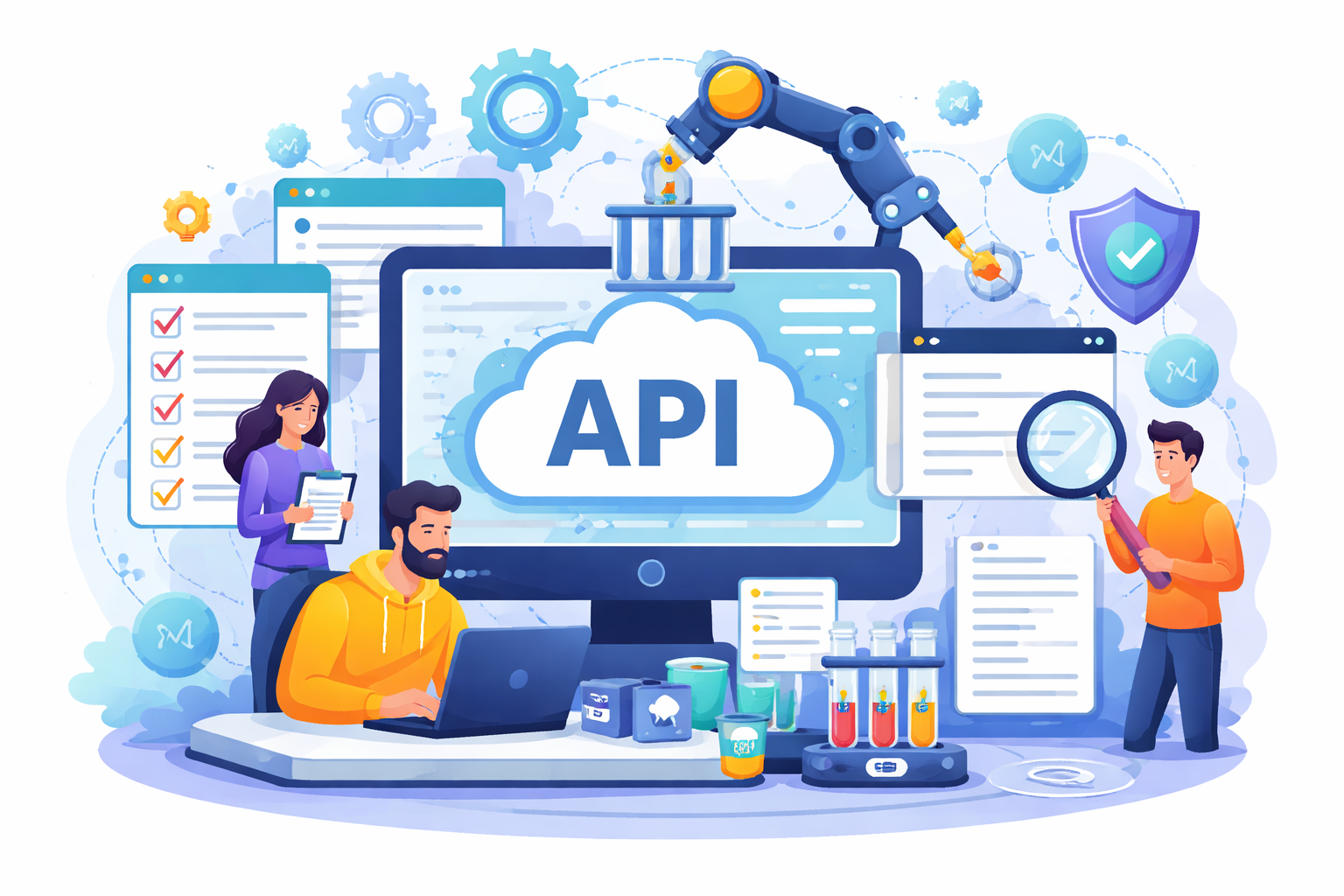
Beyond 200 OK: Building Robust API Automation Testing
In modern applications, APIs are the backbone of digital experiences. Yet, many test strategies stop at validating HTTP status codes—most commonly checking whether the response returns 200 OK. While this confirms connectivity, it does not guarantee correctness, reliability, or performance.
A truly robust API automation strategy must validate behavior, structure, limits, and performance in a systematic and repeatable way. This article outlines a practical API automation framework that ensures APIs behave correctly under all conditions and remain reliable as systems evolve.
Why “200 OK” Is Not Enough
Some APIs return HTTP 200 even when business logic fails, embedding the actual outcome inside the response body. Without validating response content, schema, pagination rules, and performance characteristics, teams risk shipping APIs that silently fail in production.
This automation framework ensures:
-
Functional correctness (business logic, schema, data integrity)
-
Performance compliance (response time, payload size, scalability)
-
Change detection (new or unexpected fields)
-
Operational readiness (caching, queue logging)
API Automation Test Coverage
Legend
F → Functional Test Case
P → Performance / Non-functional Test Case
| # | Test Type | Test Case | What Is Being Validated |
|---|---|---|---|
| 1 | F | HTTP Status Handling | API returns HTTP 200 for all parameter combinations, including error scenarios |
| 2 | F | Success Condition | "isSuccess": true and "message": "" for valid requests |
| 3 | F | Error Condition | "isSuccess": false and "message" is not empty for invalid requests |
| 4 | P | Response Size Limit | Response payload does not exceed 10 MB (client-validated limit) |
| 5 | F | Pagination Presence | Pagination implemented or not; raise warning if missing |
| 6 | P | Collection Size Limit | Result collection count does not exceed 50 records |
| 7 | F | Pagination Integrity | Validates current page, total pages, and page count equals result size |
| 8 | P | Response Time | API responds in under 3 seconds |
| 9 | F | Schema – Field Validation | All expected fields are present in the response |
| 10 | F | Schema Change Detection | New/unexpected fields cause failure and trigger test update |
| 11 | F | Schema – Data Type Validation | Field data types match the contract |
| 12 | F | Nested Fields Presence | Checks whether nested fields exist |
| 13 | F | Nested Fields Validation | Validates structure and values of nested fields |
| 14 | P | Cache Behavior | Detects whether response is served from cache |
| 15 | F | Queue Logging | Confirms request/response is logged to the queue |
Why This Approach Works
Functional Confidence
Business rules are validated explicitly—no hidden failures masked by HTTP status codes.
Performance Assurance
Response size, speed, and scalability limits are enforced automatically before production impact.
Early Change Detection
Any new fields introduced by backend changes fail fast, forcing intentional schema updates rather than silent breakage.
Production-Ready APIs
Caching and queue logging checks ensure APIs are not just correct—but operationally sound.
Final Thoughts
API automation should not merely confirm that an endpoint is alive. It should prove that the API is correct, consistent, fast, and future-proof.
By combining functional validation (F) with performance validation (P) in a single automated suite, teams can confidently scale APIs without regressions, surprises, or production fire-drills.

Nithyarani is working as Senior QA analyst in Knowillence. She has over 10 years of experience working as QA. She has worked extensively in the retail domain and has automated API testing, DB testing and Web Application testing using various testing tools. She is proficient in Agile project management as well and manages the requirements and change requests in projects very well.